ACKNOWLEDGING, celebrating & commemorating
There are moments in our lives that feel too significant to mark with a standard greeting card or a generic toast. Births, unions, losses, and renewals are the pillars upon which our identities are built. In the modern world, we often struggle to find language and rituals that truly capture the weight of these transitions.
At Oak & Thorn, I believe that the earth itself holds the wisdom we need to navigate these changes. Whether you are looking to handfast a partner, or partners, name a child or take on a new name yourself, honour a loved one who has died, or simply reaffirm the vows that bind you, the Pagan Wheel of the Year offers a profound backdrop for these ceremonies.
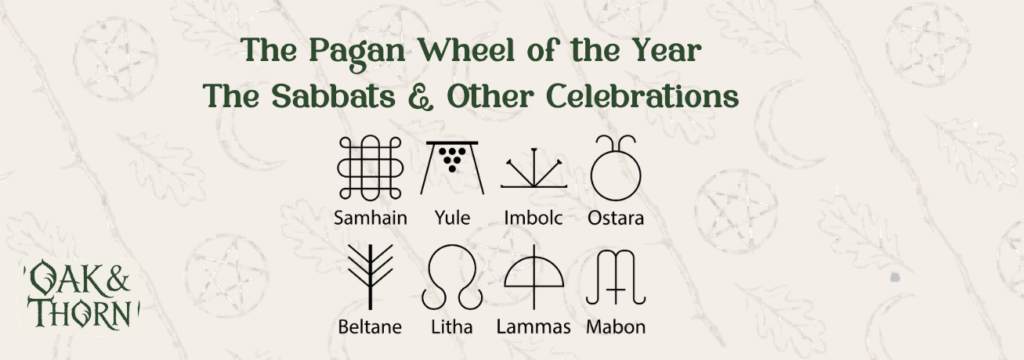
This blog series, The Oak & Thorn Year, is designed to guide you through the eight Sabbats (seasonal festivals) of the Northern Hemisphere calendar. For each season, we will explore what it means spiritually, how different traditions, specifically Wicca and Norse Heathenry, approach it, and how you can incorporate its unique energies into your own life milestones.
A Note on Terminology: Pagan, Wiccan, and Norse
Before we begin our journey around the wheel, it is important to clarify the landscape. “Pagan” is an umbrella term encompassing thousands of nature-based spiritual paths. Within this vast forest, two traditions stand out distinctly in their approach to ritual and cosmology: Wicca and Norse Heathenry (Asatru).
Wicca
Developed in the mid-20th century, Wicca is a dualistic tradition that honours the God and Goddess. It is highly structured, often revolving around the concept of the “Great Rites” where the divine masculine and feminine unite to create abundance. Wiccan ceremonies tend to be poetic, symbolic, and focused on balance, equality, and the cycle of death and rebirth. When I speak of Wiccan elements in this series, I am referring to this specific framework of duality and coven-style structure, even if adapted for solo or family practice.
Norse Heathenry (Asatru)
Rooted in the pre-Christian beliefs of Scandinavia, Norse Heathenry is not about worshipping gods as omnipotent beings, but rather acknowledging them as exemplars, forces of nature or deities. The focus is on wyrd (fate/destiny), honour, duty, and the reciprocal relationship between humans and their deities. Rituals here are often more direct, involving feasting, drinking rounds (skål), and offerings (blót). There is less emphasis than in the Wiccan tradition on magical spell-work, but nature rune and sigil magic is important especially amongst women. The emphasis is very much more on living a virtuous life worthy of the Aesir and Vanir.
Be mindful that Norse Heathenry does not follow the wheel in the same way Wicca does. There is no acknowledgement of the equinoxes or Sawhain for instance. Instead at around the same time of year they will celebrate Álfblót, celebrate a hallowed Heathen night,where the hospitality rules do not apply. More on this in the Sawhain blog.
The Oak & Thorn year & Approach
Oak & Thorn sits at the intersection of these worlds. I draw from the deep, rooted stability of the Oak, the sacred tree of Druidry and the Norse god Donar (Thor) and the protective, boundary-setting nature of the Thorn. I blend the poetic symbolism of Wicca with the grounded, ancestral respect of Norse tradition. My aim is not to dogmatise, but to provide tools. You are welcome to take the candle colour from the Wiccan tradition and pair it with the skål of the Norse, creating a ceremony that feels authentically yours.
The Four Ceremonies of Life
Throughout this series,together we will revisit four core types of ceremonies. Understanding the distinction between them is key to choosing the right ritual for your needs.
1. Marriage & Handfasting
While legally distinct, spiritually they are cousins. A handfasting is a binding of intent. Historically, it was a trial marriage, a commitment held for “a year and a day.” Today, it is often used by those who do not seek legal recognition but desire a spiritual bond. It is flexible; it can be renewed, adjusted, or dissolved. A marriage ceremony, in the Pagan context, is a solemnisation of a lifelong covenant before the divine however you percieve that and the community. Both involve the weaving of cords, the lighting of unity flames, or the sharing of salt and bread, but the handfasting retains a beautiful flexibility that acknowledges relationships are living things that grow and change.
2. Namings
A naming ceremony is the celebration of new life entering the world. This is not just for infants; it can be for any one of any age, for any reason, as well as maybe, a new business venture, a creative project, or even a pet. In Pagan tradition, naming is an act of power, it is calling forth the essence of the being into existence. These ceremonies are vibrant, joyful, and deeply connected to the spring and summer months when growth is most evident.
3. Vow Renewals
Relationships, like the seasons, undergo cycles. Sometimes the initial fire dims, or the path becomes rocky. A vow renewal is a chance to look back on the journey and look forward with fresh eyes. It is a reminder that love is not a static state but a daily choice. These are particularly powerful during the autumn equinox and winter solstice, when introspection and reflection are natural parts of the rhythm of life.
4. Memorials
Death is not an ending in Pagan belief; it is a transition. Memorial ceremonies allow us to release our grief, honour the legacy of the departed, and integrate their memory into our ongoing lives. While Samhain is the primary time for communicating with the veil-thinned dead, memorials can be held at any Sabbat. A memorial at Litha might focus on the light the person brought into the world, while one at Yule might focus on the promise of return.
How to Use This Series
Each upcoming post will follow a consistent structure to help you navigate the seasonal shifts:
The Season’s Soul: What is the spiritual meaning of this Sabbat?
Traditions Compared: How do Wiccans and Norse Heathens view this time?
The Palette: Specific colours, herbs, flowers, and crystals associated with the season.
Ceremony Guides: Practical ideas for marriages, namings, renewals, and memorials tailored to this specific energy.
The Oak & Thorn Twist:A unique ritual element or blessing inspired by our specific philosophy.
Whether you are planning a grand festival or a quiet gathering in your garden, may these words offer you inspiration. Let’s walk the wheel together, marking the beats of our hearts in time with the turning of the earth.
With thanks to Mel Maelo – White Raven Ceremonies for her guidance in relation to all things Norse Ceremony & Celebrations.
Stay tuned for my first seasonal entry: Mabon – The Autumn Equinox.
Michelle | Oak & Thorn Ceremonies
Inclusive, sustainable, and nature-centric ceremonies in Essex & Suffolk.