Everything You Need to Know About Handfasting
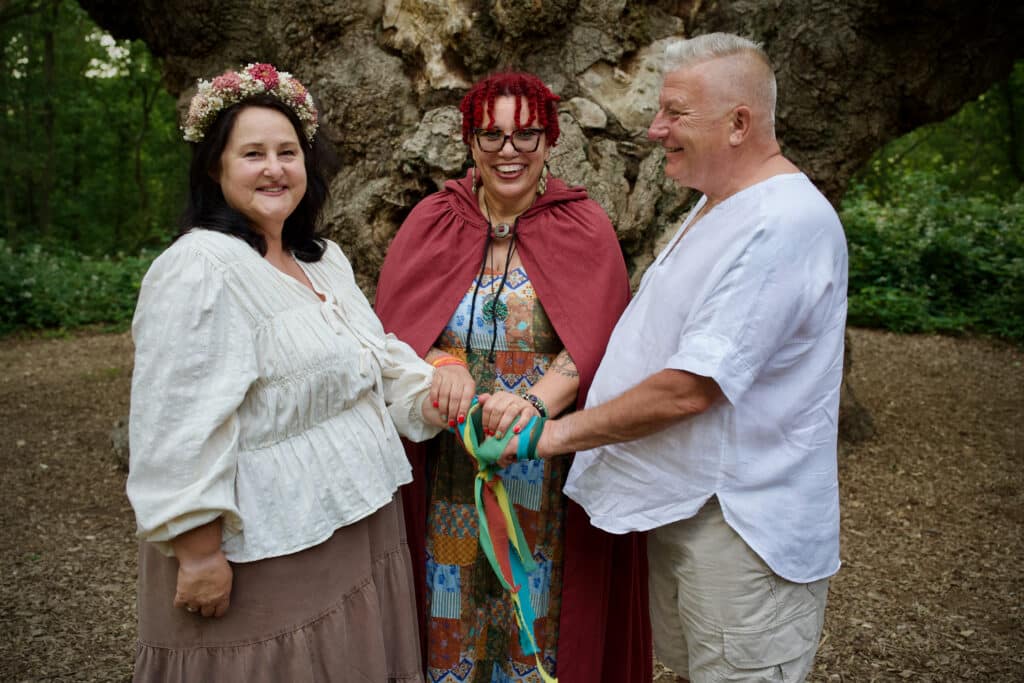
There is something about the act of binding two people’s hands together in a handfasting that goes straight to the heart. It is one of the oldest ceremonial gestures in human history, and when it happens outdoors, in a landscape that holds you, with the wind in the trees and the sky doing exactly what it likes above you… it is something else entirely.
Handfasting is having a well-deserved revival. And not just among pagans, although we do love it. People from every background and belief system are discovering what their ancestors already knew…that sometimes the most powerful thing you can do is stand in the natural world, put your hands together, and let someone bind them as you make vows to one another.
Where Does Handfasting Come From?
The history of handfasting is genuinely ancient, though like most old traditions it’s been interpreted, reinvented and romanticised along the way, so let’s dig deep and find out what we know.
The word itself comes from the Old Norse handfesta, meaning to strike a bargain by joining hands. Across the Celtic world, and in Norse and early medieval European cultures, the joining of hands was central to the making of binding agreements, including marriage. The physical act of tying was a visible, communal confirmation that something real had just happened.
In Scotland, handfasting had a specific historical meaning as a trial or betrothal period, sometimes a year and a day, after which a couple could choose to formalise their union or part ways. This is where a lot of the romantic mythology comes from, and while the “year and a day” element isn’t really what most modern handfastings are about, the spirit of it, the idea of a conscious, deliberate, chosen commitment, is very much alive.
The ritual largely faded from mainstream practice as the church consolidated its hold over marriage, but it never fully disappeared from folk memory. And from the mid twentieth century onwards, particularly through the revival of Wicca and broader neo pagan practice, it came back. Properly back.
Handfasting or Hand Tying… Is There a Difference?
You’ll see both terms used, sometimes interchangeably, sometimes with a distinction made between them. Here’s my take.
In my practice, I use the word handfasting. It’s the term with the history, the roots, the weight. It means something specific and it comes from somewhere real.
Some celebrants and couples use “hand tying” as a more secular, neutral term, particularly where the pagan or spiritual connotations of handfasting don’t feel right for them. And that’s entirely valid. The gesture is the same. The meaning is the same. What you call it is yours to decide.
What I would gently push back on is the idea that handfasting belongs only to pagans, or that non-pagan couples need to rename it to make it theirs. The history of this ritual stretches far beyond any one spiritual tradition. If the act of binding speaks to you, it’s yours. You don’t need a different word for it.
Who Can Be Handfasted?
Everyone! Any two people who want to make promises to each other and have their hands bound in the doing of it. Any gender, any background, any spiritual path or none. Couples who are also getting legally married and folk who aren’t. People who’ve been together thirty years and never had a ceremony. People who are having the ceremony instead of a conventional wedding. People who are having it in addition to one.
Handfasting belongs to whoever wants it. Full stop.
The Cords: Colour, Material and Meaning
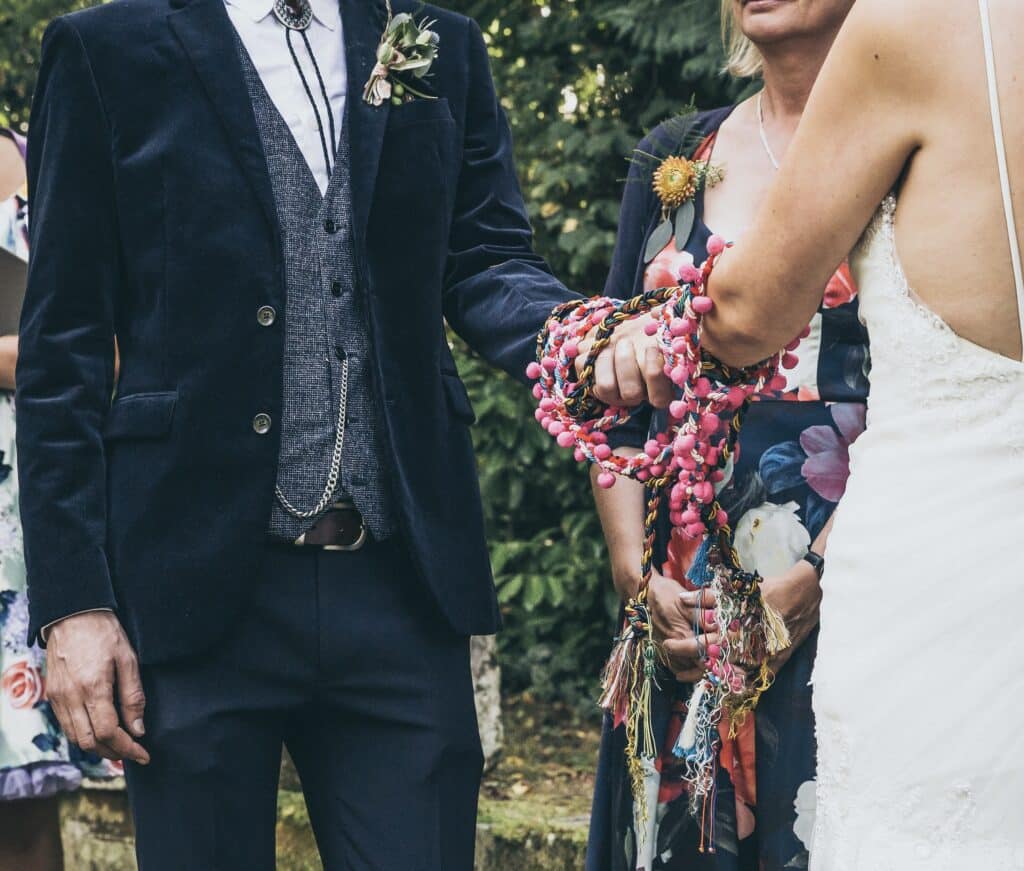
The cords are the heart of it. And choosing them is one of the most personal parts of the whole process. Traditionally, cords were made from natural materials. Wool, linen, silk, cotton, leather. At Oak & Thorn Ceremonies I encourage my handfastees to source their own cords, because the act of choosing them is already part of the ceremony. You’re already making decisions about what you want to represent your union before you’ve said a word in public.
On colour:
Colour symbolism in handfasting draws from a mix of traditions and there’s no single definitive rulebook, which is actually the point. Here are some of the most widely recognised associations, though I always encourage my handfastees to bring their own meaning and interpretation too.
Red for passion, love, strength and vitality
White or cream for purity, new beginnings and clarity
Green for growth, fertility, abundance and the natural world
Blue for loyalty, truth, wisdom and calm
Purple for spiritual connection, intuition and depth
Gold or yellow for the sun, joy, prosperity and energy
Silver for the moon, intuition and the feminine
Black for protection, the ancestors, depth and the mysteries
Orange for courage, enthusiasm and creativity
Pink for gentleness, affection and friendship
Folk often choose two or three colours that feel right for them, sometimes combining personal significance with traditional meaning. I’ve had people choose the colours of a sports team to the exact shade of moss green on a particular tree during a particular season.All of those choices are valid. All of them are theirs.
On material:
Natural fibres feel right for an outdoor handfasting. Silk is beautiful and holds a knot elegantly. Wool or woven fabric has a warmth and earthiness to it. Ribbon can be gorgeous but check it’s substantial enough to be tied and held without sliding off. Some braid their own cords, often with trinkets, crystals and keepsakes and these will add another whole layer of intention to the process. Cords are typically around a metre and a half to three metres in length, depending on what type of handfasting is required. Others will source their own and bring them to the ceremony and they are then kept for years. Most will frame them, some tie them around the bedpost. As long as the knots remained tied for as long as love shall last, it matters not how you ultimately store them.
Why Outdoors Makes It Different
You could have a handfasting indoors. Some people do. But there is something specific that happens when you take this particular ritual outside that I have never quite been able to fully explain, only witness.
Handfasting is an earth-rooted ceremony. It comes from people who stood on the land and made their promises to each other with the sky above them and the ground beneath their feet. When you recreate that, when you stand in a forest or a meadow or on a clifftop and you do the thing your ancestors did in a landscape that has been here far longer than any building… the natural world becomes a witness.
The wind picks up at exactly the right moment. The light shifts. A bird calls from somewhere in the trees. None of it is choreographed. All of it is perfect. Nature does not perform for you, but it does, in my experience always show up.
The season matters too. A handfasting at Beltane, when everything is in full, joyful bloom, carries a very different energy to one at Mabon, when the year is turning toward its quieter half and there’s something more reflective in the air. Neither is better. Both are profound. But they are not the same ceremony, and the landscape will tell you that.
What Else Sits Naturally Alongside a Handfasting?
Handfasting pairs beautifully with other rituals, and couples often weave several elements together into a ceremony that feels genuinely whole. Some of my favourites other than Jumping the Broom…
A unity ritual – blending of soils, sands or salts from meaningful places. Pouring of water from rivers or seas that matter to you. Planting of a tree or seed together. All of these work beautifully in an outdoor setting and give the ceremony a second physical focal point alongside the binding.
A fire ritual – writing intentions or what you are releasing on paper and burning them. Works particularly well at dawn or dusk, or at the fire festivals of Beltane and Samhain.
Flower or herb crowns – worn during the ceremony and then left on the land or placed in running water. Seasonal, beautiful, biodegradable.
A quaich or loving cup – sharing a drink from a single vessel, an old Scottish and Celtic tradition. Mead, wine, whisky, whatever feels right. It’s the act of sharing from one cup that matters.
An elemental acknowledgement – calling in the directions and elements as part of the opening of the ceremony. Earth, Air, Fire, Water, Spirit. Particularly meaningful in an outdoor setting where you are literally surrounded by all of them.
None of these are compulsory. Some couples want the handfasting itself to be the whole ritual, stripped back and focused. Others want a ceremony that moves through multiple moments. Both approaches are entirely right the ceremony is yours from start to finish.
Your Handfasting, Your Way
I could list everything I offer and what it costs, but honestly, a handfasting conversation starts somewhere more interesting than that.
It starts with one question, ‘What does this ceremony need to feel like for you?’
From there, everything else follows. The cords, the setting, the season, the rituals that sit alongside, the words that will be said. All of it written from scratch, all of it yours.
Handfastings start at £800. Held outdoors wherever possible, created in genuine collaboration from first conversation to final knot.
Michelle | Oak & Thorn Ceremonies Pagan Celebrant
Inclusive, sustainable, and nature-centric ceremonies in Essex & Suffolk.